Christmas Eve
This is Our Story

I am so glad to see all of you here this afternoon. Some of us come often or even all the time. Others here today may not have been here before — ever, maybe, or just since Christmas Eve last year. Each and all of you are so very welcome here tonight as we gather to hear and tell our Christmas story again together. It’s a story of wonderful and improbable inclusion, of surprising and generous welcome, where everyone has a place, and everyone’s story and experience matters, whether we’ve ever been to Emmanuel — or even to church — at all. We’re all part of this amazing story of God’s incarnation at Christmas.
The nativity story from Luke’s gospel we read tonight is the foundation of most of our common cultural memory of Jesus’ birth. Luke’s gospel is the basis of most Christmas stories, movies, hymns, songs, and pageants. It’s Luke’s gospel that gives us the story we treasure, and that we’ve all grown up with — even if we didn’t always go to church. That’s the very point of this story that is imbedded in our hearts, our carols, our favorite movies, and our deepest, oldest, and tenderest family and cultural traditions. We all know about Mary, Joseph, and the baby Jesus, laid in a manger. And we know about the cows, sheep, and donkey who were there with the holy family, right? The shepherds come after they hear the angels, and then the magi come about six days later, with their gifts for the new baby king.
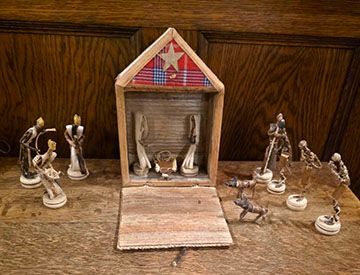
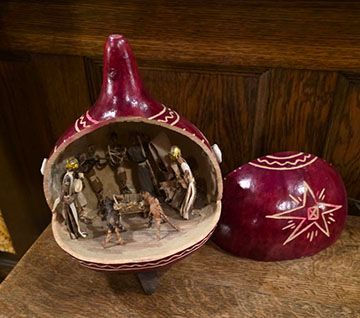
Have any of you looked closely at the nativity scenes around — maybe in pageants, shop windows, online, or on display in town centers? I love the creativity and unique lived experience expressed through these scenes, whether they’re crafted from twigs by the Masai in East Africa (I have two very different ones I’ve found on trips to Zanzibar on the bench in front of the altar). I’ve seen others with zebras, elephants, or even dinosaurs surrounding the manger. And we all remember the role of First Lobster from the pageant in Love Actually, everyone’s favorite Christmas movie ever.
Are these unexpected assortments of creatures at Jesus’ birth a crazy modern adaptation of our holy story? I believe in my heart that this wholly radical inclusion of all sorts among the witnesses to the holy miracle is exactly the point that Luke’s gospel is making, once we take a close look at what it says. Luke’s gospel tells the story of Joseph and Mary traveling to Bethlehem to be counted for the census. Luke’s gospel tells us that Mary laid the new baby king in the manger, because there was no room for them at the inn. And it’s from the idea of the manger — a food trough for animals — that we start to fill in the story in our imaginations, with details that make sense in our own culture and environment.
You know those parts: That Mary, heavily pregnant, would surely have had a donkey to ride on, as these days Bethlehem is a two-hour drive from Nazareth, so Nazareth to Bethlehem would have been a walk of several days for then heavily pregnant Mary. That, if Mary laid baby Jesus in a manger, there must surely have been cows and other livestock nearby that food dish, looking on with interest at the unfamiliar occupant of their dinner bowl. We see them on our Christmas cards and in our nativity scenes. We use our own cultural references and experience to populate the manger scene this way — all coming from Luke’s gospel’s mention of the manger, a feed trough for livestock. Because we all know that Jesus was born in a stable in a barn, right? OR DO WE?? Hold that thought.
Let’s start with a question: How is it that we find ourselves in this place — in Bethlehem — for Jesus’ birth as it’s told in the Gospel of Luke? The Angel Gabriel didn’t list traveling to Bethlehem among the instructions for this God-bearing Mary agreed to. And Bethlehem is not Mary’s hometown. Instead, the birth narrative in Luke’s gospel starts from the overlay of empire. Joseph, we are told, is descended from Bethlehem, the House of David. Joseph is betrothed to Mary, and their betrothal, and the Roman legal system, required that they both report to Joseph’s home town to be registered because that is Joseph’s ancestral home. That has nothing more to do with Mary, or her miracle pregnancy, than Joseph himself does. Whether this governmental registration is for tax purposes, military defense, or immigration controls the gospel does not tell us. But it’s really unlikely that Mary and Joseph are being counted to be sure that they have fair representation and a political voice in the Roman Empire.
In Luke’s gospel, God upends all of this. God surprises Mary, Joseph, and probably most of all, Emperor Augustus, by fulfilling God’s purposes with the birth of God’s son in Bethlehem, of all places. God totally ignores the whole secular power structure and social systems. It’s certainly not the Roman Emperor or the Roman governor who comes to greet the new baby Jesus. Instead, an angel of the Lord gets the word out to the shepherds — out in the fields, and not inside city limits and Rome’s political subdivision of Bethlehem.
A multitude of angels showed up too, also separate and apart from the social structure of Bethlehem. A multitude is a LOT of angels — surely a thousand at least. They show up to praise God and worship. God shines through all the temporal features of society’s authority in a place where everyone is welcome. The angels depart after delivering their message, and the shepherds decide to head in to Bethlehem from the fields to welcome the baby Jesus. With this whole wacky, inclusive crowd turning right to the heart of God’s presence on earth, having in common only their overwhelming hunger for God’s love, is it really that crazy to imagine those who are drawn to the manger include zebras, two-humped Bactrian camels found in cold climates like Mongolia, dinosaurs, pigs made of twigs,— or all of us here tonight?
I gave you a hold that thought a few minutes ago. We’ve been talking about context — the details that are not in our gospel account of the story, but that we fill in from our own experience. Like with such a long walk from Nazareth to Bethlehem, there must have been a donkey. And if there was a manger, Jesus must have been born in a stable in a barn. This is where the context of the Holy Land can help us. As you know from the camels’ progress through the wilderness over Advent, the Holy Land is a really rocky place. That’s why the magi need the sure-footed camels. They may have sheltered along the way in the many caves that have provided refuge to people in the Holy Land since the beginning of civilization there.
The Church of the Nativity in Bethlehem, built by the Emperor Constantine and his mother Helena in the fourth century to remember and honor the place of Jesus’ birth, is built around a cave where the church has remembered from the first century of the modern era that Jesus was born. Caves were places to shelter people and everything most precious to them that they need to survive. So when there was no room at the inn, Mary and Joseph were taken right into the heart of the family. That’s where Jesus was born in Bethlehem. Let’s ALL gather at the manger — the whole unlikely lot of us.
Let’s turn toward the prince of peace and the light of the world, following the star, and lay down our biggest hopes and our wildest, holiest dreams — the very, very best of us — next to the baby king in the manger. This story is for all of us, no matter who we are. Amen
Sermons