Pentecost 11 2026
Rivalry
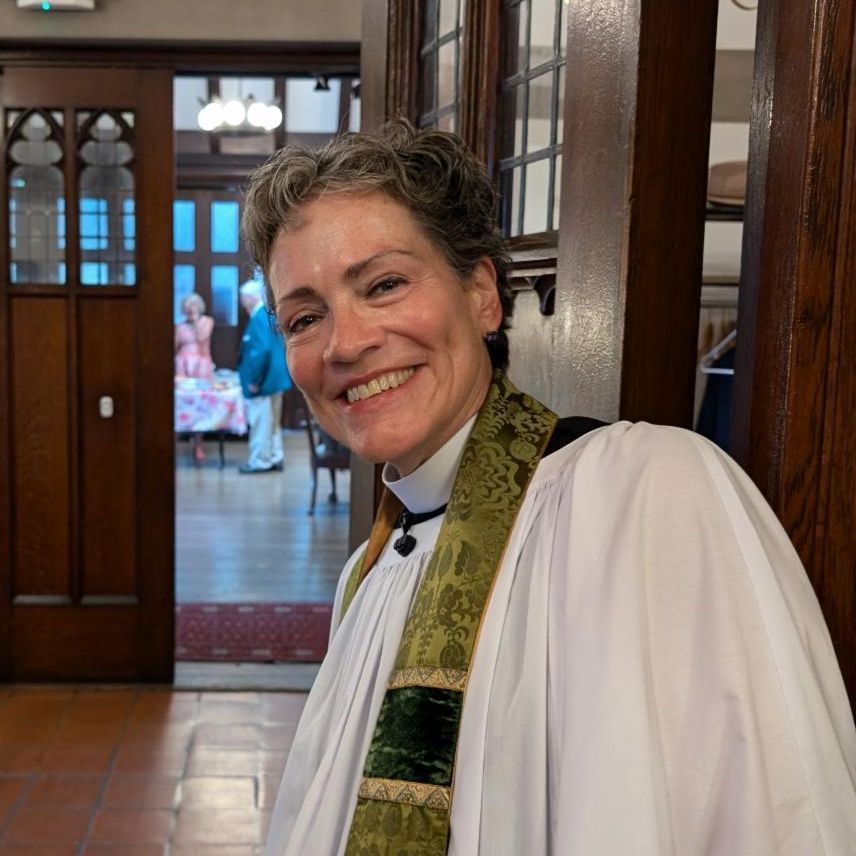
I’m leaving right after services this morning to fly to New Orleans. I’ll be staying with Judson and Sofia, our son and daughter in law, along with grandchildren 2.5 YO Whitley and George — he’s new, only four months old. It’s hard to be Whitley. She’s the firstborn child of two eldest children — the first child, the first grandchild, the first great-grandchild, the eldest cousin — you get it. She’s the focus of all adult attention no matter where she goes, and is funny, brilliant, and precocious — I say as her completely objective grandmother.
Whitley’s with her other grandmother, B, right now, and will get home on Tuesday, AFTER I have been able to spend a couple of days alone with new baby George, getting to know him without unsettling Whitley. When we’ve tried to get to know George over FaceTime over the past couple of months, poor Whitley has had a full-on meltdown, shrieking that George can’t talk to Dede — that’s me — because he is a baby!! Well you can’t fault her logic. George is indeed a baby, and he can’t talk. But I don’t think that’s really the heart of the issue. Rivalry is tough, and as a firstborn of firstborns, I’ve walked in Whitley’s shoes. And I think probably many of us are familiar with rivalry as a sibling, as a cousin, as a student in a class, in the military, on the job, on the dating scene, interviewing for a new job, you name it.
Rivalry is universal, and we see it in its rawest form playing out in the readings this morning, especially with poor Joseph, sold into slavery by his ten brothers. All ten of the older brothers were the sons of Leah, Jacob’s first wife. But Joseph, the youngest brother, was Leah’s younger sister Rachel’s son, the one Jacob really wanted to marry. The rivalry among the brothers runs on multiple levels, and the text doesn’t want us to miss it. We’re meant to stop and reflect on the older brothers’ feelings and motivations, because this resentment doesn’t come out of nowhere. It never does. Remember the backstory: Laban, Jacob’s mother Rebekah’s brother, made Jacob work seven years to marry first cousin Rachel, then switched daughters on him at the wedding — handing over Leah, the older sister, instead. Then Laban charged Jacob another seven years’ labor before he could finally marry Rachel, his original choice. Against that backdrop, the story tells us plainly that Joseph is Jacob’s favorite, not only because he came along after all his brothers, once life had eased up a little and there were more hands around to share the work, but also because he was then Rachel’s only son — the child of Jacob’s old age, and the one who carried his father’s dreams. Reuben, the eldest son, has every reason to be jealous too — everyone knows, even Joseph, that he’s his father’s favorite. But Reuben is the only one of Joseph’s ten older brothers who thinks twice about killing him. When the other brothers plot to kill Joseph, Reuben says, let us not take his life, and then again, as if for emphasis, shed no blood, and a third time, lay no hand on him.
Maybe Reuben is empathetic. Maybe he’s a father himself and feels compassion for Jacob’s paternal love for Joseph. (Joseph is 17 in this story, and all of his ten older brothers are born of one mother, so that would make Reuben no less than 26, if Leah gave birth to them one after the other — definitely father-age in the Ancient Near East). Maybe he’s a dutiful rule follower. I can tell you first hand that firstborns have a strong instinct for duty and accountability. Or maybe he’s already secure enough in his birthright as the eldest that he doesn’t need to worry that there won’t be enough to go around. (Although this whole story today starts with Joseph bringing back a “bad report” to Jacob of his older brothers’ behavior, specifically that Reuben slept with Bilha, one of his father’s wives, so Reuben’s birthright may be at risk because Joseph told on him). Complicated, but nonetheless, Joseph’s life was saved, and Joseph in turn saved his father, his brothers, and, just to make the point really clear, the Land of Egypt. A lot was at stake.
We don’t get the same insight into the disciples’ family systems as we do into Jacob, Leah, Rachel, and their progeny. But we do see the disciples jockeying for position with Jesus. Peter’s always trying to rush in with the next big idea, like building Moses, Elijah, and Jesus a house on top of Mount Tabor at the Transfiguration, while the others argue over who is greater, and who will sit at Jesus’ right and left hand. And Peter just had to be first to try walking on water in today’s gospel while Jesus watched. I’m sure we all have anxiety in our lives over whether there will be enough — enough food, enough money, enough recognition, enough love — and what we need to do or be to make sure we’re not left out of God’s plan. But I think we can live in God’s world of gracious plenty if we can keep our minds and heart on what we have instead of focusing on what we think we need but lack.
I’ve been humming Dayenu to myself around the church this week — that upbeat song of gratitude sung at Passover Seders for more than a thousand years. Dayenu means, approximately, it would have been enough, and it names our grateful wonder that any single gift from God would already be more than we deserved, and yet with God there is always more — Liberation from slavery in Egypt would have been enough. Parting the Red Sea so we could cross safely would have been enough. Manna in the wilderness would have been enough, and yet God keeps giving.
Last Sunday, Chaplain Carter preached his final sermon among us, and we blessed and sent the whole Carter family off to Naval Station Great Lakes. Duffy, Nellie, Jim Kaull, and I represented Emmanuel at Chaplain Carter’s End of Tour ceremony at the War College, where I learned that “Chaps,” as he’s informally called as XO of the Navy Chaplaincy School, is everybody’s beloved pastor — not just ours at Emmanuel. There’s plenty of grace to go around. That would have been enough on its own. And yet there is more: we get to be backup family for Brendon and Kensington while they finish out their years at St. George’s.
We saw the same grace welcoming Philip home to Newport after years away. Watching it all come together in the office would have been hilarious if it weren’t so holy — Dave and Jon huddled around a laptop with Nellie and Duffy, scrolling through Facebook Marketplace — I’m sure a new one on Dave and Jon — then piling into Dave’s truck with Nellie’s sister Mary Bridget conscripted as one more mover, the whole improbable crew circling the island collecting secondhand treasure to help make Philip a home.
That’s what it looks like when the kingdom of God draws near — nothing grand, just people of different experience, gender, generations, physical strength — and large vehicle access — going about the business of living in community and finding that somewhere along the way, they’ve become friends. Rivalry, jealousy, and fear that there’s not enough love or blessing or birthright to go around — those are normal, human, understandable feelings. It’s like that with Joseph’s brothers, their father before them, and for most of us who’ve joined their long line
of humans struggling with being human. But God always makes room at the table. Please pray with me that Dede can make enough room for Whitley, George, June, and however many more who come on my lap. Amen
Sermons