Pentecost 20
For David Graybeard
Even those of you who haven’t yet visited our friends in the Diocese of Western Tanganyika know of British primatologist and anthropologist Jane Goodall, one of DWT’s most famous inhabitants — other than Emmanuel Church’s friend Emmanuel the Bishop. When Dr. Goodall first traveled to the eastern shore of Lake Tanganyika in 1960 to study wild chimpanzees, the British government required her mother to go along, as she was only 26. She did not have a university degree. Traditional scientists criticized her work, saying she should never name her subjects, or observe their behavior in family groups or communities, because she was “anthropomorphizing” them — that is, assigning characteristics that belonged only to human beings.
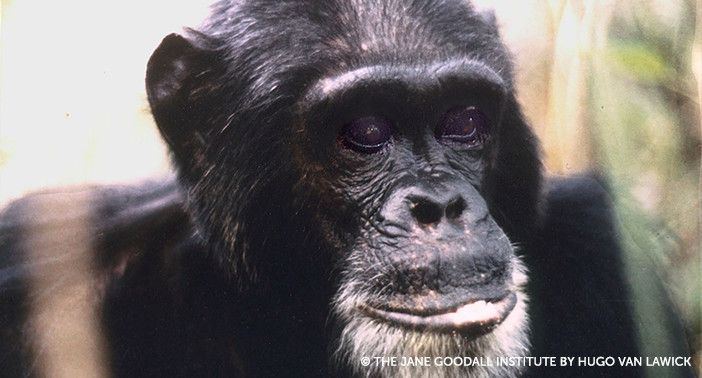
But in observing the chimps’ emotional and relational responses, and interactions in families and groups, particularly with David Graybeard, the first chimp who came to trust her, Dr. Goodall realized that humans are not alone in God’s world — not the only creatures to make tools, feel love, exist in communities, and need connection to thrive. Dr. Goodall died earlier this month at the age of 91, and while I never got to meet her at the Gombe Stream reserve, I have visited there and traveled by dhow between Gombe and Kigoma with Dr. Anthony Collins, another senior researcher, after an infamous and rather spectacular fall of about 50 feet down an embankment to the base of a waterfall, but that is, as they say, another story. I’ve been reading tributes to Jane Goodall over these days since her death, and I wonder — Is Jane Goodall’s relationship with David Graybeard a window into our current experience with difference in the world? I wonder if Jesus is inviting us to observe the Pharisee and the tax collector in today’s gospel, not with the skills of an empirical scientists, but with the empathy and compassion of our shared humanity?
Here’s the passage: Two men went up to the temple to pray, one a Pharisee and the other a tax collector, Luke’s story begins. The Pharisee, standing by himself, was praying thus, `God, I thank you that I am not like other people: thieves, rogues, adulterers, or even like this tax collector. I fast twice a week; I give a tenth of all my income.' But the tax collector, standing far off, would not even look up to heaven, but was beating his breast and saying, `God, be merciful to me, a sinner!' Luke has put the Pharisee and the tax collector together here for a reason. We’re supposed to wonder why, in this pairing, it’s the tax collector who is saved by his faith, and exactly what it is about the tax collector that we’re supposed to see and be.
We know that Jesus is always making a bad example of the Pharisees in the gospels, showing us that the Pharisees are missing God’s forest for their focus on rules about the trees. So are we all supposed to be the tax collectors? I don’t think we can jump to that conclusion. The wiki-thickets tell us that tax collectors are mentioned throughout scripture. Genesis 47:24 says that when the crop comes in, give a fifth of it to Pharaoh. Tax collectors were reviled by the Jews of Jesus' day because of their perceived greed and collaboration with the Roman occupiers. They got rich demanding tax payments in excess of what Rome levied and keeping the difference. Well, that’s not good.
And the Pharisees weren’t bad people. They were the super-conscientious sect of Jews who had committed generations and millennia to learning and following God’s rules. The Pharisees are like the very most diligent of us. They worshiped on the sabbath, loved the hymns, got excited about flowers on the altar, signed up as lectors, sang in the choir, got their pledges in by October 26 — that’s today, by the way! — participated in church work days, polished brass,volunteered in the office, and brought the gifts up at communion. So what’s the Pharisee doing wrong in this story?
I don’t know about you, but I know I can find myself doing what the Pharisee is doing. When I’m in a bind or I’m unsure of myself — I start looking around to see what others are doing — kind of checking out my own insecurities. Checking around on what others are doing is kind of a nervous tic — a self-soothing behavior that comes from a place of deep insecurity. I’m ok, right? At least I’m not as bad off as she is! So if we’re usually the Pharisees in the story, why has Luke’s gospel given us a tax collector as the foil?
Is Luke’s gospel telling us to sign on to greed and collaboration with oppressive systems of occupation? I don’t think so, even though Jesus loved the diminutive tax collector Zacchaeus, who climbed up in a sycamore tree in Jericho to better see Jesus, and Matthew the Apostle, who was also a tax collector.
But I don’t think Jesus telling us to be like the Pharisee either — keeping score of others’ mistakes in an attempt to manage our own anxieties. Luke’s gospel has set up a false comparison — making us think it’s easy to pick the right answer — be like the Pharisee, or be like the tax collector.
I think we’re supposed to be focusing on the Pharisee’s and the tax collector’s humanity and feelings, not objective scientific observations of their job descriptions. Consider Luke’s gospel’s visual description here. The tax collector is bent down. He won’t even lift his eyes up to the heavens, Luke’s gospel tells us, but instead is beating his breast and calling himself unworthy. The Pharisee, on the other hand, can’t stop checking out what everyone else is doing. You’d see the picture Luke’s gospel is painting in modern day Jerusalem. The traditional kinetic prayer of ultra Orthodox Jews is called davening, a deeply embodied prayer that engages mind, heart, and body. Davening is also, when you see it, a really effective mechanism — a metaphor, in Luke’s gospel — for looking around and comparing ourselves to others, when we should instead be modeling ourselves on God.
As former Andover Newton dean Mary Luti writes, the Pharisee is there to pray, but what he delivers is his own report card, thinking he’s doing pretty well compared with some of the other screw-ups around him — particularly that tax collector. God is a passive audience whose job is to applaud when the Pharisee’s judgy report is done. Listening in, we learn nothing about who God is and what God does, but we do get a pretty clear idea about the Pharisee’s score card. The tax collector, on the other hand, seems to have faith — that deep assurance of God’s kindness, even knowing his own weaknesses, and even though he’s never seen God. His faith tells him that God will be merciful, comparing him to others, but loving him incomparably because he’s made in God’s image.
This is an insight that comes not from scientific observation, quantification, and measurement, but through empathy and compassion, genuinely seeing each other’s humanity, through all of our differences, and forming a community that cares for all of us. This comes through our communal worship, our community dinners, our collaboration with Newport Classical, our community programming, and our Angel Space.
Our God is a God of deep kindness,
who aches with our pain,
and would reach out in tenderness to comfort us,
giving us early rain for our vindication.
God will repay us for the years that the swarming locust has eaten,
the hopper, the destroyer, and the cutter,
and we shall eat in plenty and be satisfied,
and praise the name of the Lord our God,
who has dealt wondrously with us. Amen
Bishop Greg Rickel for our use in the church:
Gracious and loving God, giver of all that is good and true and beautiful and life-giving. These pledges represent our sweat, they represent our lives, they represent our dreams. They are but tokens of the awesome gifts that have been given to us and they are pledged in thanksgiving for all we have received, for all we have been inspired to be, for all we are challenged to become, in this place.
May they be the first fruits of all we have and not what we have left over, so that we may live out as closely as possible how you give to us. May we see them as our offering to you, sacred, holy, yet earthy, filled with possibilities. May we hold this image in our hearts and minds so as we watch our offerings each week come to your table, we can see our very selves being part of this offering, it is us on the table, living sacrifices to you. Amen
Sermons